
What Is the Difference Between F1, F1B, and F1BB Labradoodles?
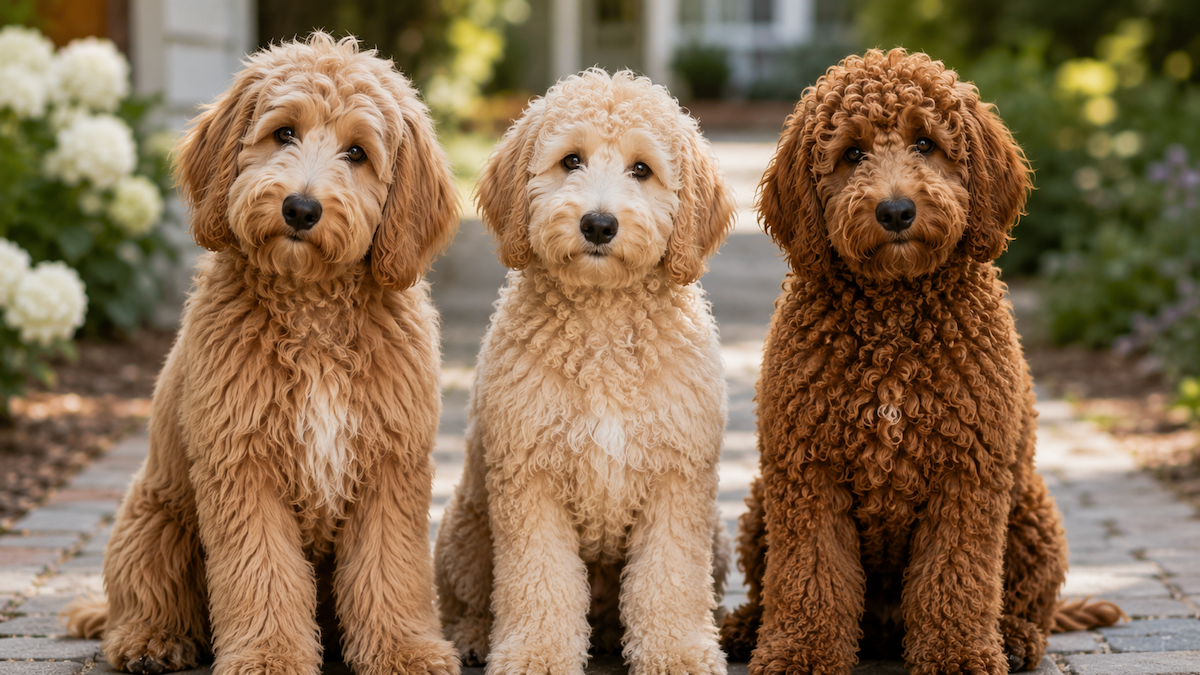
Choosing a Labradoodle sounds straightforward until you start looking at breeder listings and discover that the dogs come labelled with letter and number combinations that mean nothing at first glance. F1. F1B. F1BB. Multigen. These are generation codes, and they carry real practical information about what coat, shedding level, and allergy suitability you can realistically expect from a particular puppy. Understanding them before you commit to a purchase or deposit is genuinely worthwhile.
The confusion is understandable because the codes are not intuitive unless you know the system. They refer to how many generations of selective breeding separate the puppy from its original Labrador and Poodle ancestors, and which direction the later crosses went. Each generation shifts the genetic balance in ways that tend to affect the coat, and therefore the shedding and the allergy profile.
Quick Answer: An F1 Labradoodle is a first-generation cross between a purebred Labrador and a purebred Poodle, producing roughly 50 percent of each. An F1B is a first-generation Labradoodle bred back to a Poodle, producing approximately 75 percent Poodle genetics and typically a curlier, lower-shedding coat. An F1BB is an F1B bred back to a Poodle again, producing approximately 87.5 percent Poodle genetics and the highest likelihood of a low-shedding, allergy-friendlier coat.
What the F and B Letters Mean
The F stands for filial, a term used in genetics to indicate the generation of a cross. F1 is the first filial generation, meaning the first cross. The B stands for backcross, which means crossing back to one of the original parent breeds. When breeders use B, it almost always means back to the Poodle, because Poodle genetics are associated with low shedding and the wavy or curly coats that many Labradoodle buyers are specifically seeking.
Every time a B is added to the code, it reflects another backcross to the Poodle. So an F1B is an F1 bred back to a Poodle (one backcross), and an F1BB is that F1B bred back to a Poodle again (two backcrosses). Each round increases the proportion of Poodle genetics in the resulting puppies.
F1 Labradoodles: The Classic First Cross
The F1 Labradoodle is genetically half Labrador and half Poodle. This is where the term hybrid vigour is most applicable: the diversity of genetic background that results from crossing two distinct purebred lines can contribute to overall health and robustness, though this effect is sometimes overstated in breeding marketing.
Coats in F1 Labradoodles are often wavy rather than tightly curled, and they fall somewhere between the Labrador's flat, dense coat and the Poodle's tight curls. Shedding in F1s is more variable than in later generations because the genetic lottery produces puppies with different proportions of each parent's coat characteristics. Some F1 puppies shed more like Labradors; others take more after the Poodle parent.
For families where allergies are a major concern, F1 Labradoodles are not the most reliable option because of this variability. For families who want a Labradoodle with a somewhat more natural, less maintained coat and who are not significantly allergy-sensitive, F1s can be a good fit.
F1B Labradoodles: More Poodle, Less Shedding
The F1B is the most commonly produced generation in most Labradoodle breeding programs. With roughly 75 percent Poodle genetics, F1Bs are significantly more likely than F1s to carry the non-shedding coat traits associated with the Poodle parent. Most F1Bs have wavy to curly coats with much lower shedding than an F1.
This generation is often recommended for families with mild to moderate dog allergies, because the reduced shedding also means less dander distributed around the home. The coat is typically more consistent across the litter than in an F1, though individual variation still exists. An F1B puppy from a health-tested, well-selected breeding program is one of the more predictable Labradoodle options available.
The grooming needs differ significantly between an F1 and an F1B: the curlier the coat, the more regular brushing and professional grooming it requires to prevent matting and keep the dog comfortable. Families choosing F1B puppies should factor in the grooming commitment.
F1BB Labradoodles: Maximum Poodle Influence
The F1BB carries approximately 87.5 percent Poodle genetics. This generation typically has the tightest, curliest coats and the most consistent low-shedding profile. For families with significant dog allergies, F1BB Labradoodles are often the generation most likely to produce a genuinely allergy-friendlier experience.
It is worth noting that no dog is truly hypoallergenic. Allergic reactions to dogs are caused primarily by the Fel d 1 protein found in saliva, urine, and skin cells, not only by shed hair. Reduced shedding does reduce the amount of dander and allergen distributed around the home, which is why higher Poodle-content Labradoodles tend to be better tolerated by allergy sufferers, but the tolerance is individual rather than guaranteed.
The maintenance requirement for an F1BB coat is the highest of the three generations covered here. Tight curls matt more easily and more quickly than looser waves, and professional grooming appointments need to be more frequent to keep the coat in good condition.
Multigen Labradoodles: Beyond the First Crosses
A multigen (or multigenerational) Labradoodle is produced by breeding two Labradoodles together rather than crossing back to a purebred Poodle. Multigenerationals are the result of several generations of Labradoodle-to-Labradoodle breeding and are what most Australian Labradoodle programs produce. The coat, health, and temperament can be more predictable in established multigenerational lines where breeders have been carefully selecting over many generations.
Multigenerational Labradoodles often have the most consistent fleece or wool coats, which are the coat types most associated with low shedding and allergy-friendlier characteristics. A reputable breeder producing multigenerationals typically has a well-documented breeding history that allows more confident predictions about what to expect.
Which Generation Is Right for Your Family
The decision between generations should be based on three practical factors: how sensitive your household is to dog allergies, how much grooming time and expense you are willing to commit to, and what coat appearance you prefer. Higher Poodle-content generations offer more consistent low-shedding coats at the cost of higher grooming maintenance. Lower Poodle-content generations may shed more but can have looser, easier-to-maintain coats.
Regardless of which generation you choose, the fundamentals of raising a Labradoodle puppy successfully are similar: early socialisation, consistent training, appropriate nutrition, and regular health care all contribute more to a well-adjusted adult dog than the specific generation of the Labradoodle's lineage.
The health and dietary needs of Labradoodles do not vary significantly by generation, though individual health traits can be influenced by the underlying genetics inherited from either parent breed.
Good socialisation regardless of generation is one of the most consistent predictors of a well-behaved and adaptable adult Labradoodle.
Frequently Asked Questions
Is an F1B Labradoodle always better for allergies than an F1?
F1B Labradoodles have a higher proportion of Poodle genetics and are more likely to have low-shedding coats, which generally means less allergen distribution around the home. However, individual variation within any generation means outcomes are not guaranteed. Spending time with a specific puppy or its parents before committing can give allergy sufferers a more accurate picture.
Do F1BB Labradoodles have more health problems than F1s?
There is no evidence that F1BB Labradoodles have more health problems as a direct result of their higher Poodle genetics. Health outcomes in Labradoodles are more strongly affected by the health testing practices of the breeder, the underlying health of the parent dogs, and the overall genetic diversity of the breeding program than by the specific generation.
What is the difference between a wavy coat and a curly coat in Labradoodles?
A wavy coat falls between the flat Labrador coat and the tight Poodle curl, giving it a loose, flowing wave that many people find easy to maintain. A curly coat is tighter and more Poodle-like, tends to shed less, but mats more easily and requires more frequent brushing and grooming. F1s and some F1Bs tend toward wavy; F1BBs and multigenerationals more often produce curly coats.
Can you tell from a puppy's appearance which generation it will most resemble?
To some extent. A tighter, curlier coat as a puppy tends to stay curly. A flatter, wavier coat as a puppy may develop either way. The parent dogs' coats provide a reasonable guide to what the litter will produce, particularly when the breeder has a track record with that pairing. No prediction is perfect because of natural genetic variation within litters.
Is a multigen Labradoodle the same as an Australian Labradoodle?
Not exactly. Australian Labradoodle breeding programs typically introduce additional breeds beyond just Labrador and Poodle to establish certain traits in the lineage. A multigen from a program that uses only Labrador and Poodle lineage is different from a true Australian Labradoodle, though both are multigenerational. The specific breeding history matters and should be disclosed by any reputable breeder.
The Bottom Line
F1, F1B, and F1BB Labradoodles differ primarily in the proportion of Poodle genetics they carry, which directly influences coat type, shedding level, and the consistency of those traits across litters. Understanding the generation before buying helps set realistic expectations about what you are bringing home.
All About The Doodles is a trusted resource for Labradoodle owners and prospective owners navigating every aspect of the breed. Browse the articles section for guidance on everything from selecting a puppy to caring for your Labradoodle at every life stage.