
How to Teach a Labradoodle to Come When Called Every Time
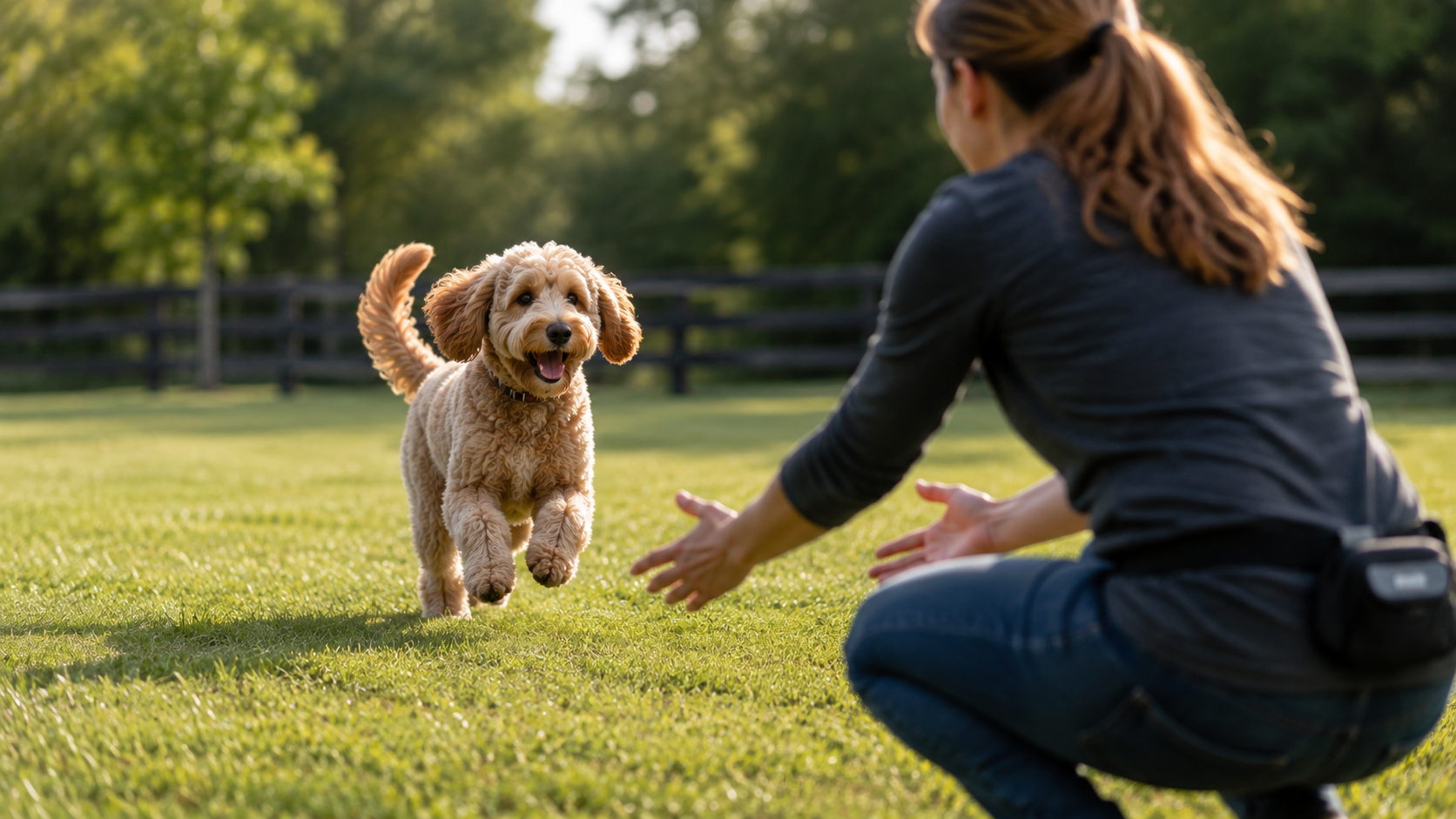
Recall is the single most important command a dog can know, and it is also the one that most owners discover they have not trained reliably until the moment they need it most: a gate left open, a leash that slips, a park encounter that escalates. A Labradoodle who comes when called every time, in every environment, under every distraction, is a safe dog. One that comes sometimes, in familiar settings, with few competing interests, is a dog waiting for a situation where that sometimes is not enough.
Labradoodles are intelligent, eager to please, and highly food-motivated, which makes them genuinely good candidates for reliable recall training. But intelligence without the right training foundation can work against you: a smart dog who has learned that sometimes ignoring the recall carries no consequence will reliably ignore it in proportion to how interesting the alternative is. The method matters as much as the breed's natural aptitude.
Quick Answer: Teach recall by pairing the command with the highest-value rewards you have, starting at very short distances with zero distractions and building gradually to greater distance and real-world environments. Never punish a dog who comes to you, even if they took too long. Never use the recall command to end something fun without compensating with something equally rewarding. Every recall must be worth the dog's while, and the dog must learn that coming to you is always the best available option.
The Foundation: Making Come the Best Thing That Happens
The entire reliability of a recall rests on one principle: the dog's experience of coming to you must always be better than whatever they were doing before you called. A dog who has learned that recall means the end of the walk, the end of the game, or getting put in the crate will eventually start weighing that equation and deciding it is not worth the trade. A dog who has learned that recall means an extraordinary treat, enthusiastic praise, and then returning to play has no reason not to come.
This means the recall reward must be the best thing in your training toolkit, reserved specifically for this command. Whatever your Labradoodle finds irresistible, a particular type of treat, a specific toy, wild enthusiastic praise, that is what comes out only when they nail a recall. The ordinary treat used for sit and down stays ordinary. Recall gets the premium reward every single time, especially in the early training stages.
This approach reflects the core principle of positive reinforcement training: the behaviour you reward most generously is the behaviour that becomes most reliable. Recall that is rewarded at the same level as a sit will become roughly as reliable as a sit, which is not reliable enough for a safety command.
Building the Recall in Stages
The biggest mistake owners make with recall training is jumping to real-world environments too quickly. A dog that has only practised recall in the garden is not ready for recall in the park. The training must build in stages, each stage adding one new challenge. Here is a practical progression:
● Stage 1: Indoors, zero distraction. Call the dog from two to three metres away. Reward extravagantly every time. Do this dozens of times.
● Stage 2: Garden or enclosed outdoor space, minimal distraction. Begin to increase distance gradually. The dog should succeed at least 90 percent of the time before adding difficulty.
● Stage 3: Outdoors with mild distractions (another person present, familiar smells). Use a long line for safety so the dog cannot self-reward by ignoring you and running off.
● Stage 4: Real-world environments with increasing distraction. The long line stays on until recall is near-100 percent reliable at each stage before moving to the next.
Patience in this progression is not optional. Moving too fast is the primary reason recall training fails. A Labradoodle that is set up to succeed at each stage builds a history of recall being rewarded that becomes the strongest predictor of future behaviour.
The Long Line: Your Most Useful Training Tool
A long line, typically a 15 to 30 metre lightweight lead attached to a harness, is the single most useful piece of equipment in recall training. It allows the dog apparent freedom while preventing the self-rewarding experience of ignoring the recall and continuing to run around. When the dog ignores the command, you simply walk toward them, pick up the line, gently bring them to you, and reward calmly when they arrive. No drama, no punishment, just a quiet retrieval followed by a less exciting reward than a voluntary recall would have earned.
The long line teaches the dog that they cannot successfully ignore the recall while giving them enough freedom that the training feels natural rather than constrained. Never call the dog while holding the end of the line and then jerking them toward you: this teaches the dog to dread the command rather than respond to it willingly.
Never Punish a Dog Who Comes to You
This is the rule that most owners break without realising they are breaking it. Calling a dog who has done something wrong and then scolding them when they arrive does not punish the original offence: it punishes the act of coming. From the dog's perspective, they came when called and were met with anger. The lesson they take from this is that coming when called is associated with bad outcomes.
If your Labradoodle has done something you want to address, go to them rather than calling them to you for the correction. Protect the recall command from any association with negative experience, even if it is inconvenient in the moment. The long-term reliability of the recall is worth the short-term awkwardness of walking across the park to address whatever happened.
Maintaining Reliability Over Time
Recall training is not a one-time exercise. It requires consistent reinforcement throughout the dog's life. A recall that was reliable at eight months old will begin to deteriorate if it is never rewarded and never practised. Intermittent reinforcement of the recall, using the premium reward randomly rather than every time once the behaviour is established, actually maintains the behaviour more robustly than constant reward. The dog that never knows when the jackpot is coming stays more engaged than one who expects it predictably. This principle connects directly to the broader idea of first-year training priorities: the skills taught in the first year need maintenance throughout adulthood, not just completion in puppyhood.
As your Labradoodle encounters more environments through socialisation and distraction, practising the recall in each new environment confirms for the dog that the command applies everywhere, not just at home. A recall only trained in the garden is a garden recall, not a universal one.
A strong recall also pairs well with clear training boundaries around greetings, play, and access to spaces, because a dog who returns to you reliably is one you can manage calmly in situations that would otherwise escalate.
Frequently Asked Questions
My Labradoodle ignores the recall at the park. What am I doing wrong?
The most common cause is that the training has not been built up to the park's level of distraction. The park is one of the hardest environments for recall training because it contains many highly rewarding alternatives. Go back to practising in lower-distraction outdoor settings, reward extravagantly, and use a long line to prevent failure in the park until the dog's success rate is consistently high in easier environments.
Should I use a different word if my recall is already poisoned?
Yes, if your current recall cue has been consistently associated with the end of fun or with negative outcomes, it can be worth starting fresh with a new word or whistle. Build the new cue from scratch with only positive associations and never let it acquire negative ones.
How long does it take to train a reliable recall?
A reliable recall in low-distraction settings can be established in two to four weeks of daily practice. Building to reliable recall in high-distraction real-world environments typically takes three to six months of consistent staged training. The investment is entirely worth it given the safety implications.
Can I use a whistle for recall instead of a word?
Yes, and many trainers prefer a whistle because it has a consistent sound that does not carry the emotional tone that a human voice can accidentally. A whistle recall is trained exactly the same way as a verbal recall: consistent cue, immediate reward, gradual distraction building.
My Labradoodle comes but stops a metre away and circles. How do I fix this?
This usually means the dog is uncertain about what happens when they arrive all the way. Build a clear habit of requiring the dog to come all the way to hand-touch or sit in front of you before rewarding. Do not reach out to take their collar before rewarding: some dogs circle to avoid collar grabs. Reward the arrival position specifically, then practise occasional collar touches paired with a treat so the collar grab itself is not aversive.
The Bottom Line
A reliable Labradoodle recall is built on one foundation: every recall experience must be worth more to the dog than whatever else was available. That means premium rewards, no negative associations, a gradual distraction progression, and lifelong maintenance. The investment in getting this right is one of the most practically valuable things you will do for your dog's safety.
All About The Doodles covers Labradoodle training from first commands through advanced skills. Browse the articles section for guidance on building the well-mannered, reliably trained dog this breed is capable of being.