
How Do You Potty Train a Labradoodle Puppy Fast?
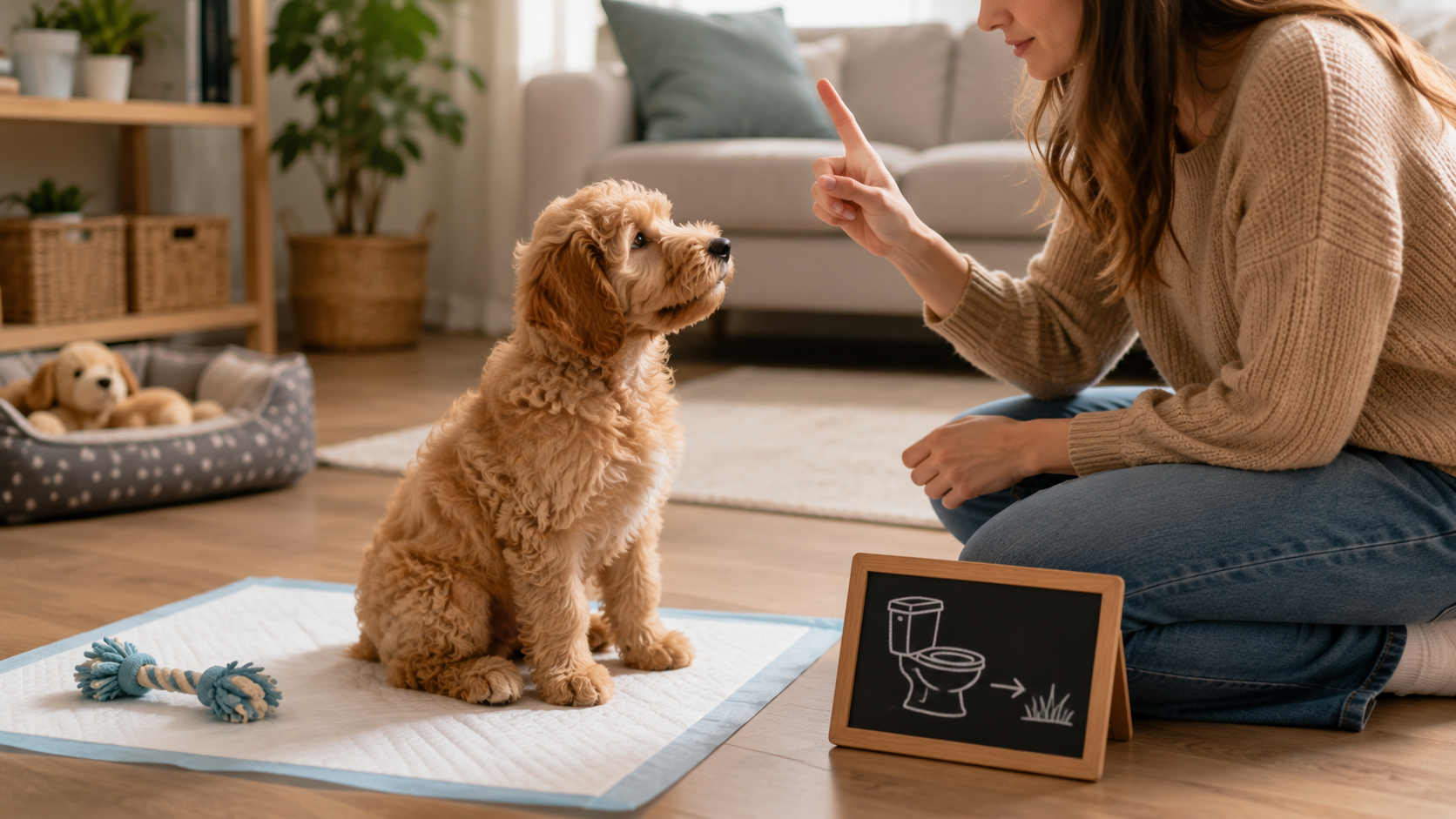
Potty training is one of the first challenges every new puppy owner faces, and it is also the one most people feel least prepared for. A Labradoodle puppy arriving home is typically eight to twelve weeks old, with a bladder that cannot hold urine for more than a couple of hours and no concept of where the household expects them to eliminate. The accidents that follow are not defiance or slow learning: they are physics and biology.
Labradoodles are genuinely intelligent dogs, and that intelligence works in your favour during potty training when the process is set up correctly. The key is not punishment for mistakes but an environment and a routine that makes success more likely than failure, so the puppy builds a reliable association between the outdoor area and the act of eliminating. Once that association is established, it holds.
Quick Answer: The fastest way to potty train a Labradoodle puppy is to take them outside to the same spot every 45 to 60 minutes during the day, immediately after sleeping, eating, and playing, and to reward outdoor elimination instantly with praise and a treat. Crate training overnight and during unsupervised periods prevents accidents and accelerates the training by leveraging the puppy's instinct not to soil their sleeping area. Most Labradoodle puppies are reliably house trained within four to eight weeks with a consistent routine.
Understanding Puppy Bladder Capacity
A young puppy cannot hold their bladder for long periods, and understanding this prevents the frustration that comes from expecting too much too soon. A rough guideline is that a puppy can hold their bladder for approximately one hour for every month of age, with a maximum of four to five hours even in adult dogs overnight. A ten-week-old puppy can realistically hold it for about two hours during the day and may need to go out once overnight.
This means that the first few weeks of potty training are labour-intensive by necessity. Trips outside need to happen on a schedule that accounts for the puppy's physical limitations, not just when it seems convenient. Setting an alarm or timer to prompt outdoor trips every 45 to 60 minutes during waking hours removes the guesswork and reduces the number of indoor accidents significantly.
The Role of Crate Training
Crate training and potty training work together because they rely on the same instinct. Dogs are naturally reluctant to soil the area where they sleep. A properly sized crate, big enough for the puppy to stand, turn, and lie down comfortably but not so large that they can use one corner as a toilet, channels this instinct into a powerful training tool. A puppy kept in a crate overnight or during unsupervised periods will hold their bladder because the alternative is fouling their sleeping space.
This does not mean the crate is a long-term solution for bladder management. It means that during the early training weeks, the combination of scheduled outdoor trips and crate use during gaps significantly reduces the opportunities for indoor accidents. Fewer accidents means faster progress, because the puppy is not reinforcing the indoor elimination behaviour that makes training take longer.
Introduce the crate positively from the beginning. Feed meals in it, place comfortable bedding inside, and allow the puppy to enter and exit freely before beginning to close the door. A crate that the puppy associates with comfort and security is far more effective than one they associate with confinement and distress.
The Outdoor Routine That Works
Every potty training system that works is built on consistency of location and timing. Take the puppy to the same outdoor spot every time. The scent of previous eliminations is a powerful prompt that tells the puppy what this area is for. Varying the location extends the time to each outdoor success because the puppy needs to re-establish the association with each new spot.
The timing of outdoor trips should be predictable and include the following trigger moments without exception: first thing in the morning, immediately after every meal, immediately after every nap, after every play session, and last thing before bed. These are the highest-probability moments for elimination, and capturing them consistently produces rapid progress.
Building a potty schedule into a consistent daily schedule for the whole day makes the routine automatic for both the owner and the puppy, which is one of the strongest predictors of how quickly house training is completed.
Rewarding the Right Behaviour
The reward must happen immediately after the outdoor elimination, within two to three seconds of the act finishing. Positive reinforcement training works because the dog connects the reward to the behaviour that immediately preceded it. A treat given when the puppy walks back inside is too late: by then they have moved on from the act of eliminating and are thinking about what is inside.
Verbal praise delivered in an enthusiastic, warm tone at the moment of outdoor elimination is as important as the treat. Over time, the verbal marker becomes its own reinforcer. Most puppies respond beautifully to the combination of immediate praise and a high-value treat given the instant they finish going outside.
How to Handle Indoor Accidents
Indoor accidents will happen during the training period. How they are handled matters significantly. Punishing a puppy for an accident that has already happened is not effective, because the puppy cannot connect the punishment to an act that occurred minutes ago. All punishment achieves is making the puppy fearful of eliminating in front of you, which can make outdoor potty trips more difficult as the puppy becomes reluctant to go while being watched.
The right response to finding an accident is to clean it thoroughly with an enzymatic cleaner that neutralises the odour. Standard household cleaners mask the scent to human noses but not to dog noses, and any residual scent signals to the puppy that this is an acceptable location. Enzymatic cleaners break down the odour at a molecular level and remove the prompt.
If you catch the puppy in the act, a calm but firm verbal interruption followed immediately by taking them outside and waiting for them to finish is the correct response. If they finish outside, give the full reward. The correction is the interruption and redirection, not a punitive response.
Common Mistakes That Slow Training Down
Several common mistakes significantly extend the time it takes to house train a Labradoodle puppy. The most impactful is giving the puppy too much unsupervised freedom too soon. A puppy roaming freely through multiple rooms during the early training weeks will have accidents in locations you are not monitoring, which reinforce the indoor elimination behaviour. Clear household boundaries established from the beginning include limiting the puppy's access to the parts of the house where they cannot be directly supervised.
A second common mistake is inconsistency between household members. If one person takes the puppy out on a schedule and another does not, or if some accidents are cleaned properly and others are not, the mixed signals slow the training. The entire household needs to follow the same routine for the training to progress at its fastest rate.
The guidance on raising a new puppy consistently points to consistency as the single most important factor in how quickly a puppy learns the expectations of their new home.
Frequently Asked Questions
How long does it take to potty train a Labradoodle puppy?
Most Labradoodle puppies reach reliable house training within four to eight weeks of consistent effort. Some puppies achieve this faster, particularly those with attentive owners who follow a strict schedule from day one. Some take slightly longer, particularly if there are inconsistencies in the routine or if the puppy has been in an environment where indoor elimination was previously unrestricted.
Should I use puppy pads during potty training?
Puppy pads teach puppies that eliminating inside is acceptable in certain locations, which can create confusion and extend the overall house training timeline. If pads are used, they should be phased out as quickly as possible and moved progressively closer to the door and then outside. For most healthy puppies in a home where outdoor access is available, going straight to outdoor training is the most efficient approach.
What if my Labradoodle puppy goes potty immediately after coming inside?
This usually means the outdoor trip was too short and the puppy did not fully empty their bladder. Spend longer outside, and wait until the puppy has actually eliminated before coming back in. Using a consistent verbal cue like 'go potty' while outside helps the puppy understand what the outdoor trip is for and speeds up the process.
Is it normal for a potty-trained puppy to have regressions?
Yes, regressions can happen during periods of change, stress, illness, or when there are disruptions to the usual schedule. A regression to occasional accidents after reliable house training has been established is usually short-lived. Returning briefly to the original close supervision and scheduled outdoor trips typically resolves it quickly.
At what age are most Labradoodle puppies reliably house trained?
Most Labradoodle puppies reach reliable house training somewhere between four and six months of age with consistent effort. Younger puppies have physical limitations on bladder control that even perfect training cannot fully overcome. As the puppy matures and bladder capacity increases, the final reliability typically falls into place.
The Bottom Line
The fastest potty training for a Labradoodle puppy comes from a consistent outdoor schedule, crate training during unsupervised periods, immediate reward for outdoor success, and proper cleanup of any indoor accidents. With these elements in place, most puppies are reliably trained within four to eight weeks.
All About The Doodles covers every stage of Labradoodle puppy life. Browse the articles section for more practical guidance on training, routine, health, and making the most of the puppy months.